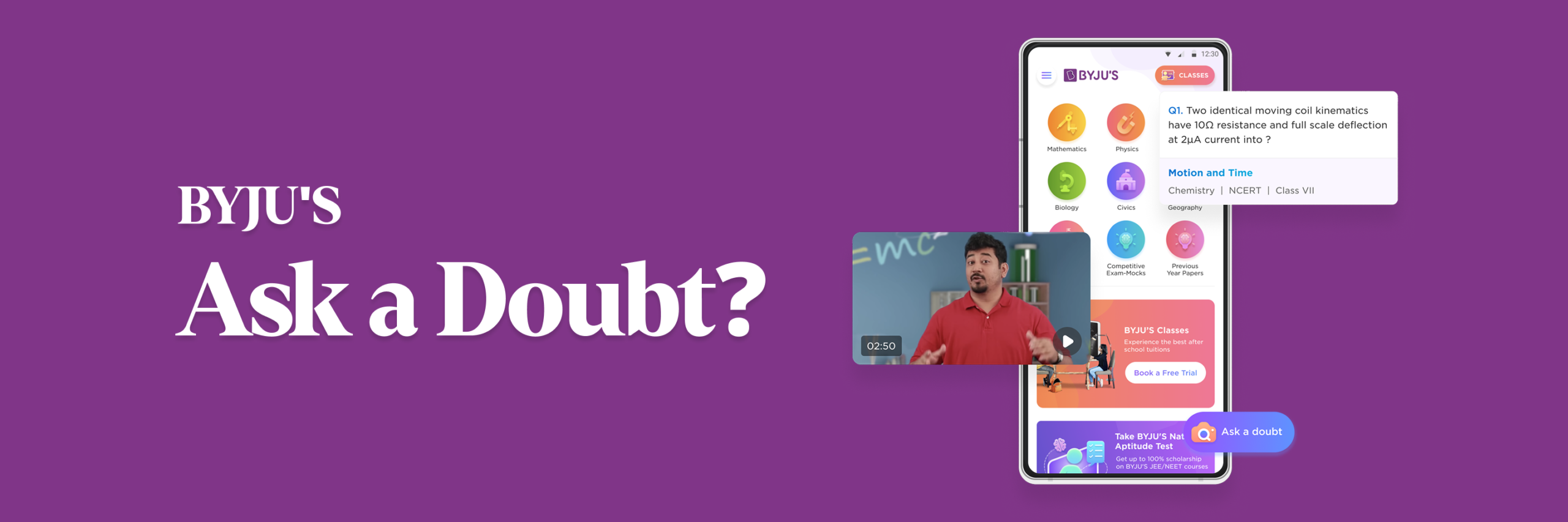
Designing a 0→1 doubt-solving experience inside India’s largest K12 learning app
Overview
Timeline: 2 months (Aug 2021 – Oct 2021)
Team: UX Designer, UI Designer, Motion Designer, Product Managers, Engineers
Platform: iOS & Android
Impact: +27% increase in app usage
Role: Product Design Manager
I led the design and delivery of “Ask a Doubt” a new feature introduced within the existing BYJU’S K12 app to simplify content discovery and enable students to ask questions using text or images.
The Problem
Despite having vast content, students struggled to find specific answers inside the app.
Key issues:
- Discovery required 3+ navigation steps
- No fast way to ask specific doubts
- Repeated feedback from mentors and students
- App reviews highlighted search frustration
The opportunity:
- Introduce a fast, intuitive doubt-solving system without disrupting the existing product architecture.
Key Insights
From interviews, mentor discussions, and app feedback:
Students search in 3 contexts:
- While studying
- During homework
- While revising for exams
Many prefer capturing images instead of typing long queries.
Trust depends on:
- Instant results
- Clear explanations
- Escalation to human support if needed
Poor discovery reduces engagement and increases frustration.
Product Strategy
We designed Ask a Doubt as a layered experience, not just a search feature.
The system included:
1) Floating CTA for high discoverability
2) Image-based question capture
3) Text-based search option
4) Smart result page with:
- Video explanation
- Text solution
- Related questions
- Recommended videos
5) Escalation path → “Ask a Tutor”
6) Feedback loop (like/dislike/report)
The goal was to reduce friction while increasing reliability and trust.
Core Experience Decisions
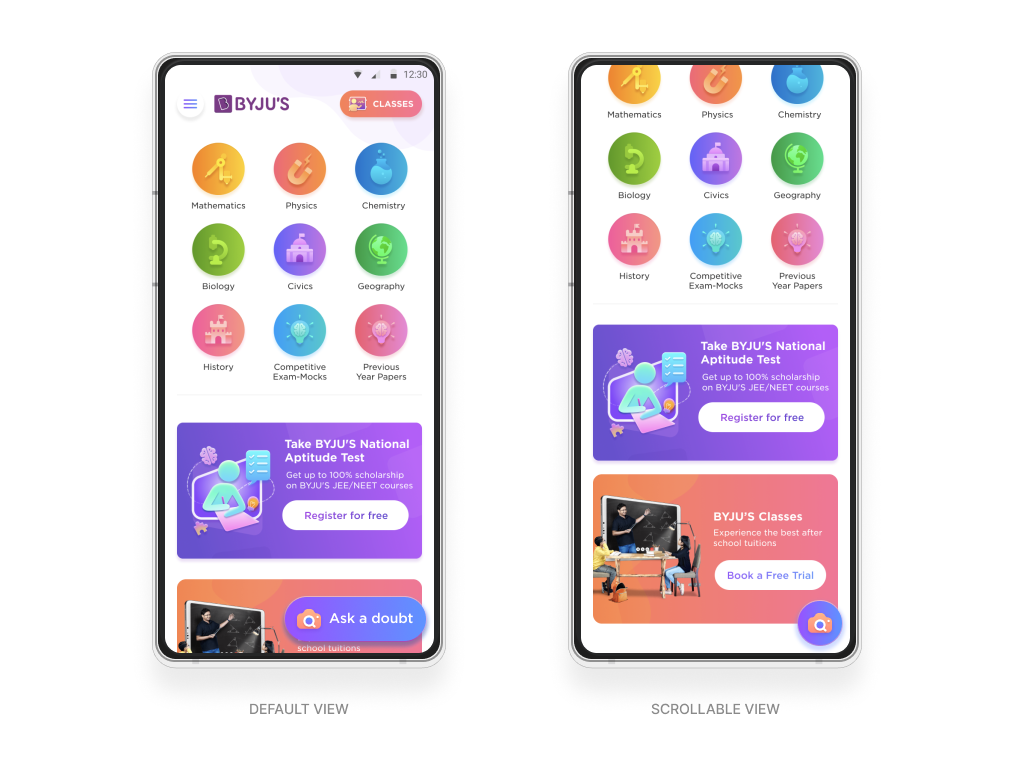
1. Floating CTA on Home
Added a persistent but lightweight entry point without cluttering the homepage.
Why:
Maintain visibility without disrupting core learning journeys.
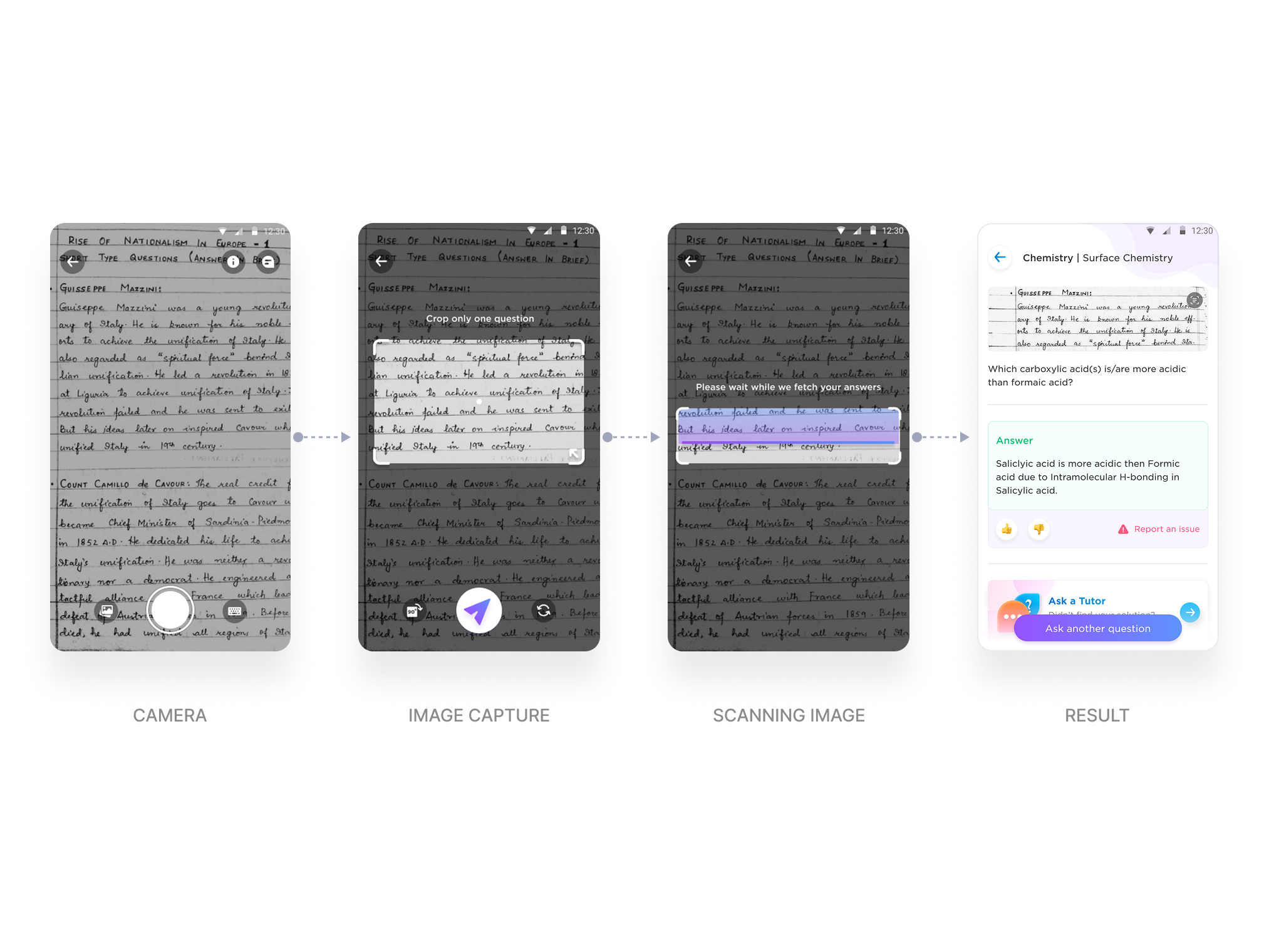
2. Camera-First Flow
Enabled students to capture textbook questions instantly.
Why:
Faster than typing long academic queries.
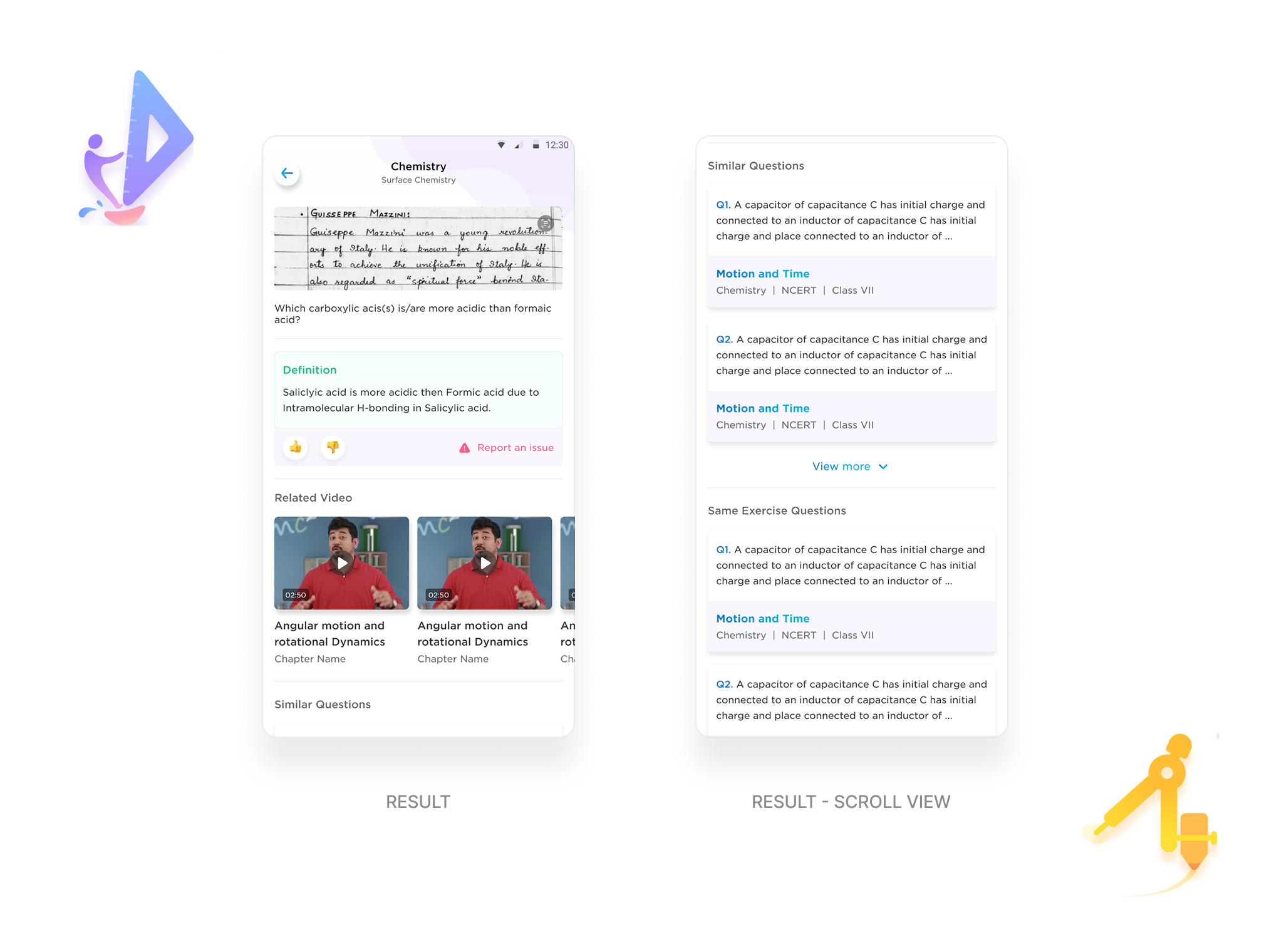
3. Solution Page as Trust Hub
Designed the result page to include:
- Immediate answer
- Related videos
- Recommended questions
- Feedback option
Why:
Reinforce credibility and reduce doubt abandonment.
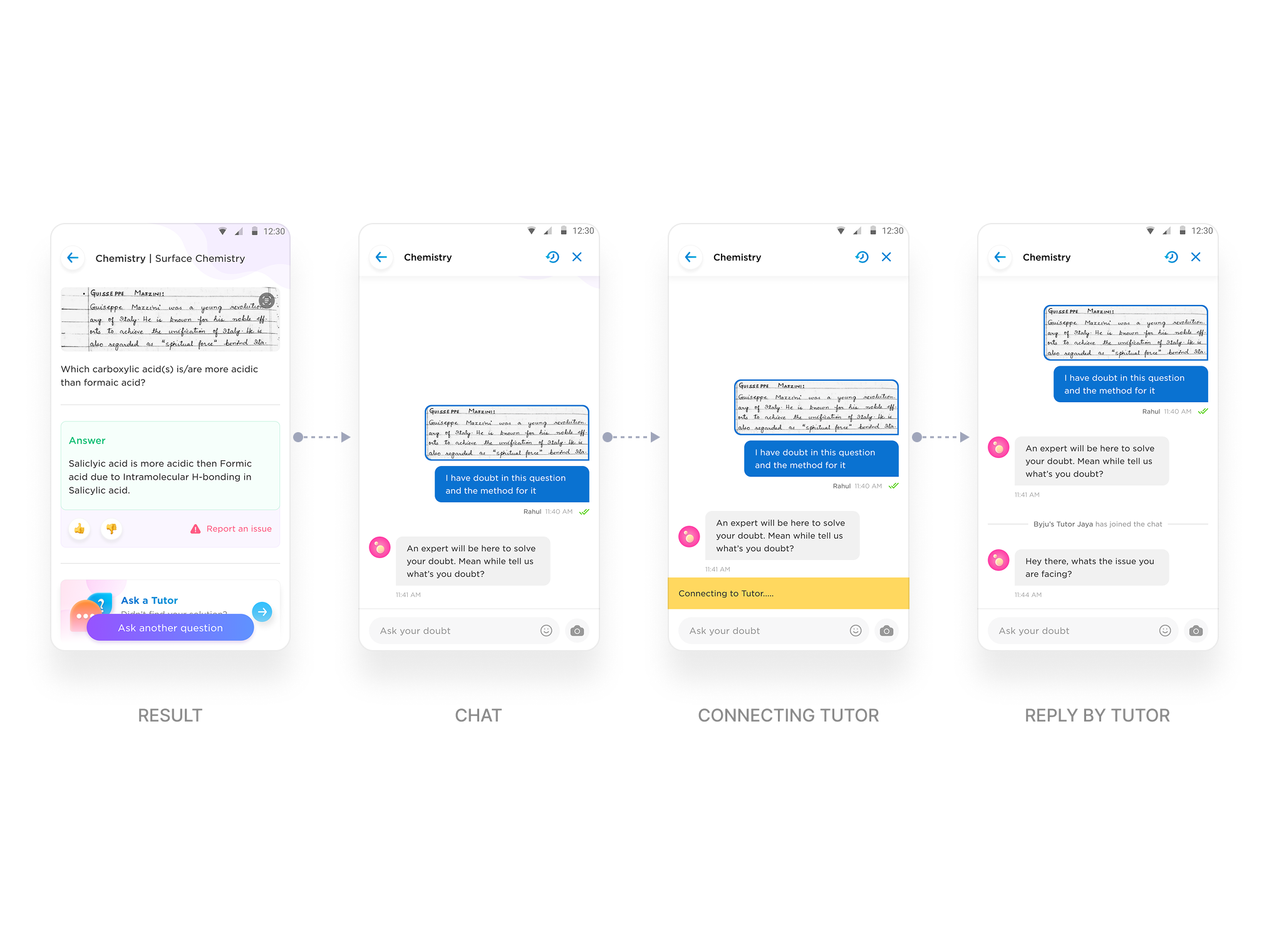
4. Escalation to Tutor
If automated answer wasn’t sufficient, students could connect with a tutor.
Why:
Safety net for edge cases → increased confidence in system.
Leadership & Collaboration
As Product Designe Manager, I:
- Facilitated alignment between Product, Engineering, and Business teams
- Balanced innovation with constraints of an existing large-scale system
- Guided team execution through design sprints
- Ensured design consistency across iOS and Android
- Handled stakeholder expectations within tight timeline
Impact
+27% increase in app usage
following feature launch, attributed to improved content discoverability within the K12 platform.
Camera-first adoption was dominant
the image-based question capture became the primary input method, validating the decision to lead with camera over text search.
Low escalation to human tutors
the majority of student doubts were resolved through the automated answer layer, confirming the solution page design was doing its job: immediate answer, related videos, and feedback loop reduced the need for human intervention.
Positive qualitative signal from mentors and students
feedback confirmed that surfacing answers in fewer steps reduced the frustration that had shown up repeatedly in app reviews.
Shipped in 2 months inside one of India's largest K12 apps - without disrupting existing product architecture.
Reflection
Designing inside a large, mature product requires:
- Respecting existing systems
- Aligning multiple stakeholders
- Introducing change without disruption
This project reinforced my belief that strong product design balances:
- Business goals
- User behaviour
- System constraints
Let’s build thoughtful, scalable products.
Open to senior IC and design leadership roles. If you're building something interesting, let’s talk.
📱 +91 9847580241
📄 Resume
Elsewhere:
© 2026 Sooraj. Designed with intention.